

How to Read a COA for Hemp Flower: A Plain-English Guide
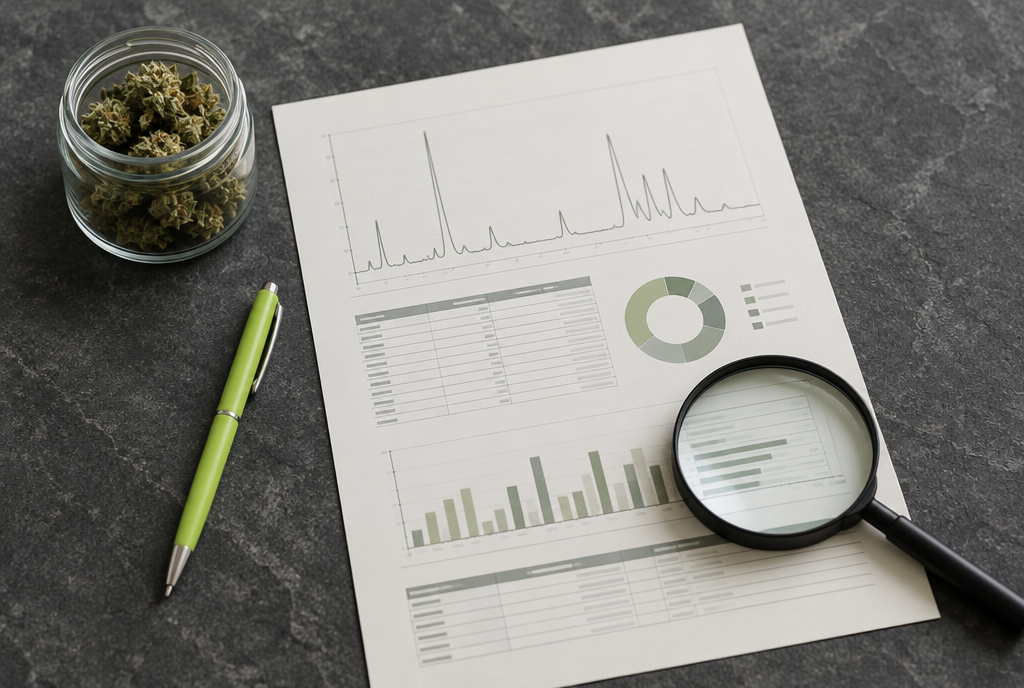
A certificate of analysis, or COA, is a report from a testing lab that shows what the lab found in a specific sample of a product. If you buy hemp flower, learning to read one is one of the most useful things you can do. It takes a few minutes the first time, and after that you will be able to scan a COA in seconds.
Lab reports do not all look the same, but most share the same core sections. Here is what to look for.
1. The header: who, what and when
The top of a COA usually lists the basics. Check these first:
- Lab name and accreditation. Most reports name the lab and note its accreditation, often ISO/IEC 17025.
- Sample name. This should match the strain or product name you are looking at.
- Sample ID or batch number. A unique code the lab uses to track that specific sample.
- Dates. You may see a date the sample was received, a date it was tested and a date the report was issued.
- Sample type. For flower, this is often listed as "plant," "flower" or "bud."
Match the COA to the product
The single most important habit: make sure the name on the COA matches the product you are considering. A COA for one strain tells you nothing about a different one. Then check the date. Newer reports reflect more recent batches, and hemp flower changes over time as it ages.
2. The cannabinoid table
This is the heart of the report. It lists cannabinoids such as THCA, Delta-9 THC, CBD, CBDA, CBG and CBGA, usually in two units:
- Percent (%), which is the share of the sample's weight.
- mg/g, or milligrams per gram. To convert, 1% equals 10 mg/g.
For THCA flower, you will typically see a high THCA number and a much lower Delta-9 THC number. That is expected, and the next section explains why it matters.
Dry weight
Many reports note whether results are on a "dry weight" basis, often with a moisture percentage nearby. Hemp rules are generally written around dry weight, so this detail is worth a glance.
3. Understanding Total THC
THCA is not the same as Delta-9 THC, but it converts into Delta-9 THC when heated. Labs account for this with a standard formula:
Total THC = Delta-9 THC + (0.877 x THCA)
The 0.877 factor reflects the weight THCA loses when it converts. Here is a simple example using made-up numbers: if a sample shows 0.2% Delta-9 THC and 20% THCA, the Total THC is 0.2 + (0.877 x 20) = 17.74%.
Many COAs calculate Total THC for you. If yours does not, you can do the math with the formula above. Total cannabinoids, when listed, is the sum of everything the lab measured.
4. LOQ, LOD and ND
These abbreviations show up in nearly every report:
- LOD (limit of detection) is the lowest amount the lab's method can reliably detect.
- LOQ (limit of quantitation) is the lowest amount the method can reliably measure as a number.
- ND (not detected) means the compound was not found above the detection limit.
- <LOQ means something was detected, but at a level too low to measure precisely.
ND does not always mean "zero." It means "below what this test can see."
5. Contaminant panels, if present
Some COAs cover only cannabinoids. Others, often called "full panel" reports, add safety screens. If they are included, you may see:
- Pesticides
- Heavy metals, such as lead, arsenic, cadmium and mercury
- Microbials, such as mold, yeast, E. coli and salmonella
- Mycotoxins
- Residual solvents, more common on concentrate reports
- Moisture and water activity
Each line usually shows a result, the limit it was compared against and a "Pass" or "Fail." If a panel is not listed, the report simply does not cover it.
A quick COA checklist
- Does the product name match?
- Is the test date reasonably recent?
- What are the THCA, Delta-9 THC and Total THC numbers?
- Are results on a dry-weight basis?
- Which contaminant panels, if any, are included, and did they pass?
A quick responsible-use note
Leaf Lab sells only to adults 21 and older. Hemp-derived products can cause a positive drug test. Hemp laws vary by state and keep changing, so check the rules where you live. Never drive or operate machinery after using THC products, and keep all products away from kids and pets.
Look up a COA
Leaf Lab keeps its certificates of analysis in a searchable library. Search by product name on our COA's page and try the checklist above. Questions about a report? Get in touch.


